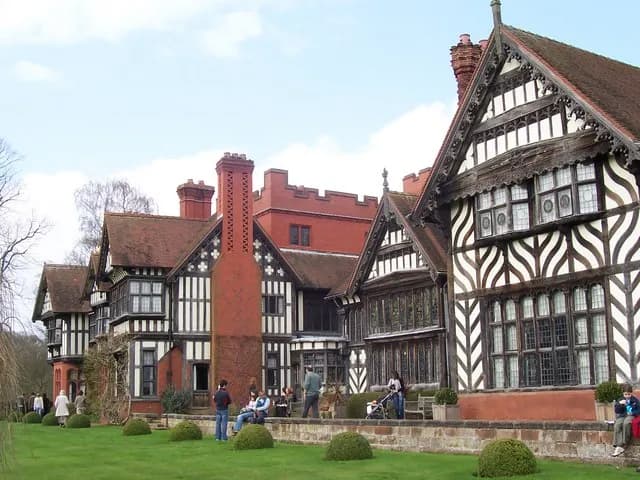
Three miles west of Wolverhampton city centre lies a remarkable testament to Victorian aesthetic ideals. Wightwick Manor stands as one of the finest surviving examples of an Arts and Crafts house, its walls adorned with Pre-Raphaelite masterpieces and its rooms embodying the principles of beauty championed by Oscar Wilde.
The House Oscar Wilde Inspired
The manor owes its existence to a single lecture. In 1884, Oscar Wilde delivered a talk titled "The House Beautiful" in Wolverhampton, espousing the Aesthetic Movement's philosophy of "art for art's sake." Samuel Theodore Mander, of the Mander Brothers paint and varnish manufacturing family, was in attendance. Inspired, he commissioned architect Edward Ould to create a home that would put Wilde's principles into practice.
Construction began in 1887 on Wightwick Bank and continued in two phases. The initial western half, complete with a billiard room, was completed that same year. In 1893, an eastern wing doubled the property's size, adding five guest bedrooms, a great parlour, a dining room and a replacement billiard room. The result is a Grade I listed Tudor Revival masterpiece built in the "Old English" style.
A Pre-Raphaelite Collection Without Equal
Wightwick Manor houses one of the most significant Pre-Raphaelite collections in Britain. Works by Dante Gabriel Rossetti, Edward Burne-Jones, Ford Madox Brown, John Everett Millais and Evelyn De Morgan hang within its walls. The collection holds particular distinction for its representation of female artists; with thirteen professional women artists on permanent display, Wightwick displays more work by women than any other National Trust property.
The interiors feature extensive William Morris & Co. designs throughout, including wall hangings, wallpapers and upholstery. Tiles by William De Morgan and stained glass by Charles Kempe add to the visual richness. The dining room boasts an elaborate pendant imitation Jacobean plaster ceiling designed by Leonard Shuffrey.
The De Morgan connection runs deep. During the Second World War, the De Morgan Foundation collection was evacuated to Wightwick for safekeeping from the London Blitz. Today, the De Morgan Gallery in the Old Malthouse houses this collection on permanent loan. A William De Morgan Tile Library, opened in January 2024 in the Malthouse Gallery attic, displays over 400 unique tiles arranged in colour order.
The Rossettis Exhibition: Summer 2026
From 2 June to 8 November 2026, Wightwick hosts "The Rossettis: Siblings and Spouses," a major exhibition bringing together previously unseen works by Dante Gabriel Rossetti. The exhibition includes early lithographs, satirical playing cards and a newly acquired portrait of Christina Rossetti. Twelve works by Elizabeth Siddal, many rarely displayed together, form a significant part of the exhibition. Early Rossetti drawings created between the ages of fourteen and eighteen, not seen since 2019, are also on display.
Gardens and Grounds
The manor sits within seventeen acres of woodland and gardens designed by Thomas Mawson in the Arts and Crafts style. The grounds feature orchards, pools, formal gardens and the Mathematical Bridge, which underwent conservation work in January 2025. The kitchen garden includes a heated peach house, repaired in December 2024 as part of the ongoing Big MEND conservation project.
The Mander Legacy
The house remained a family home until Sir Geoffrey Mander, Liberal MP and paint manufacturer, donated it to the National Trust in 1937. Remarkably, it was only fifty years old at the time, making it the first property of such recent construction accepted under the Country Houses Scheme Act. The Mander family retained a private apartment, an arrangement that continues today. Geoffrey and his wife Rosalie Mander served as live-in curators well into the late twentieth century, personally caring for the collection they had gifted to the nation.
Visiting Wightwick Manor
The National Trust property is open to the public daily, with the manor house accessible from 11:00 to 17:00 and gardens from 10:00 to 17:00. The Malthouse Gallery and the recently opened De Morgan Tile Library are included in admission. A tea-room serves breakfast baps, light lunches and refreshments, whilst the Old Manor Shop stocks William Morris and Arts & Crafts products. Family admission is £45, with individual adult tickets at £18. National Trust members enter free.
Beyond the house and art, visitors will find a woodland play area with a climbing tower and balance walk. The 2026 events calendar includes open-air theatre performances of "A Midsummer Night's Dream" on 24 and 25 July, alongside embroidery and pressed flower workshops.
A Wolverhampton Treasure
Wightwick Manor represents a unique intersection of Wolverhampton's industrial heritage and cultural refinement. The Mander family built their fortune on paint and varnish manufacture, established in 1773, yet used that wealth to create and preserve a monument to artistic beauty. For Wolverhampton residents, the manor offers a world-class art collection and historic house experience without leaving the city's boundaries.
The property sits on Wightwick Bank, just off the A454 Wolverhampton to Bridgnorth road. Brown tourist signs guide visitors from the Chapel Ash junction of the Wolverhampton ring road. Whether drawn by the Pre-Raphaelite paintings, the William Morris interiors or the Arts and Crafts gardens, Wightwick Manor stands as evidence that extraordinary cultural treasures can indeed be found just around the corner.