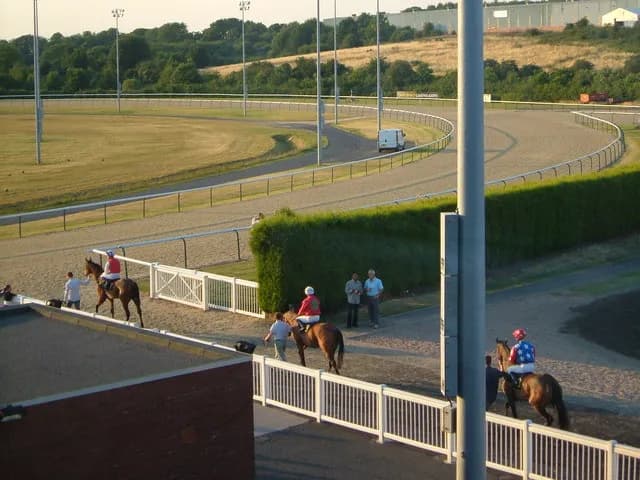
There is something about racing under floodlights that changes the atmosphere completely.
As a racegoer, I enjoy a traditional afternoon meeting, but autumn evening racing has a character of its own. You can arrive while there is still a little daylight left, watch the temperature drop and, before long, the horses are coming into the straight beneath the lights.
Few places are more closely associated with that style of racing than Wolverhampton.
Dunstall Park made British racing history in 1993 when it became the country's first floodlit racecourse. More than three decades later, evening racing remains a big part of its identity.
October is one of the best months to experience it.
The month's racing began with an afternoon fixture on Friday 2 October, but there are still five meetings to come:
Monday 5 October
Tuesday 13 October
Monday 19 October
Friday 23 October
Tuesday 27 October
By the final meeting, the clocks will have gone back and Dunstall Park will be firmly into its autumn-night setting.
A racecourse that has kept changing
Wolverhampton's racing history stretches much further back than the floodlights.
Racing began in the town in 1825 before moving to Dunstall Park in 1888. The first meeting at the current site was held on 13 August that year.
The biggest transformation came in the 1990s, when the course was redeveloped for all-weather racing and floodlights were installed. Queen Elizabeth II officially reopened the new-look racecourse in 1994.
The surface has changed several times since then. Polytrack arrived in 2004, before Wolverhampton became the first racecourse in Britain to install Tapeta in 2014. It remains the surface used today.
That year-round surface is one of the things that makes Wolverhampton different. When traditional Flat racing on turf begins to wind down for the year, Dunstall Park keeps going.
For racegoers, that means there is still plenty of racing to watch as autumn turns into winter.
What I watch for at Wolverhampton
Dunstall Park is a tight track, and that is part of what makes racing here interesting.
Position can matter. Horses do not have an enormous home straight in which to recover after getting caught behind rivals or travelling wider than ideal around the bends.
That can make the races tactical, particularly when a jockey is trying to find the right position before the field turns for home.
I also like spending some time around the parade ring rather than simply finding a seat and staying there all evening.
Seeing the horses close up before a race is part of the experience. You can watch how they are behaving, see which ones look relaxed or on their toes, then move trackside before the runners head to the start.
It is one of the parts of racing that television never quite recreates.
Standing beside the track, you hear the hooves, the crowd and the jockeys as the horses come past. Even a fairly ordinary handicap on the racecard can suddenly feel much more exciting when you are standing close to the action.
You do not need to be a serious punter to enjoy it either. Personally, I would rather watch the horses beforehand, pick one or two that interest me and enjoy the race than spend the whole evening watching prices move on a screen.
Horses and greyhounds at Dunstall Park
Wolverhampton has changed again recently.
Greyhound racing began at a newly built track inside the horse racing circuit in September 2025.
Then, on 7 March 2026, Dunstall Park staged the UK's first combined horse and greyhound racing fixture.
That has made Wolverhampton unusual even by British racing standards. It is currently the only racecourse in Britain staging both horse and greyhound racing.
The course's biggest horse race remains the Lady Wulfruna Stakes, held each March and named after the historic figure associated with Wolverhampton's name.
October evenings are very different from those bigger race days, though, and that is part of their appeal.
They feel more relaxed.
You can turn up for an evening's racing without treating it as a major occasion, walk between the parade ring and the track, grab something to eat or drink between races and simply enjoy a few hours at the course.
Going racing at Dunstall Park
For an October evening, my main advice is simple: dress for the weather rather than the photograph.
Wolverhampton is a fairly relaxed racecourse, but a lot of the experience involves moving between indoor and outdoor areas. By the middle or end of October, standing beside the track after sunset can feel considerably colder than it did when you arrived.
A decent coat and sensible footwear are worth having.
The course is also relatively easy to reach. Dunstall Park sits just off the A449 on the north-western side of Wolverhampton, with substantial parking on site.
Wolverhampton railway station is a few miles away, so anyone travelling by train can make the final part of the journey by taxi.
That accessibility is one of the things I like about Wolverhampton.
Going racing here does not need to become an all-day expedition. You can finish work, head across to Dunstall Park and spend an autumn evening watching horses race beneath the lights.
And when the field turns into that short home straight, with the floodlights shining down on the Tapeta and the crowd beginning to lift, Wolverhampton reminds you why night racing has worked here for more than 30 years.