In 1742, a young merchant named Thomas Mander arrived in Wolverhampton, then a modest market town of just 7,500 souls. He could not have known that his descendants would build an industrial empire that would reshape not only the physical landscape of the town but its cultural and civic character for more than two centuries.
From Varnish to Empire
The Mander story in Wolverhampton began when Thomas Mander, a younger son from a family of Warwickshire franklins, settled in John Street, an area that now forms the core of the modern city centre. He had inherited property there through his wife Elizabeth Clemson's family. In 1773, Thomas's sons, Benjamin and John, established the business that would become Mander Brothers, initially trading as maltsters and manufacturers.
By 1820, the firm had evolved into Mander, Weaver & Co., operating one of the largest chemical manufacturing works in the country. A formal partnership of Mander Brothers was established in 1845 by Charles Benjamin Mander and Samuel Small Mander, concentrating on varnish manufacture. The business would grow to become the number one manufacturer of varnishes, paints, and printing inks in the British Empire.
The Progressive Industrialists
The Mander family distinguished themselves not merely through commercial success but through an unusually progressive approach to both labour relations and civic duty. Benjamin and John Mander campaigned against the slave trade and founded chapels, libraries, and schools in Wolverhampton.
Charles Mander (1780–1853), who founded the varnish works in 1803, was a notable penal reformer. He successfully petitioned for the repeal of the Blood Money Act in 1818. His rescue of two soldiers from the gallows became the subject of a novel by Samuel Warren.
Perhaps the family's most significant labour reform came in September 1932, when Sir Geoffrey Mander made Mander Brothers the first British company to introduce the 40-hour working week. The agreement was mediated by Ernest Bevin, then general secretary of the Transport and General Workers' Union.
Civic Leadership and Public Service
Sir Charles Tertius Mander, 1st Baronet (1852–1929), served as Mayor of Wolverhampton four times between 1892 and 1896. He was created a baronet on 8 July 1911 and received the freedom of the borough in 1897. His tenure as mayor was marked by extraordinary hospitality, including the distribution of warm underwear to cabmen, tram conductors, and drivers, and a dinner at the Agricultural Hall for 1,000 destitute children.
His brother, (Samuel) Theodore Mander (1853–1900), also served as mayor and died in office. Theodore was an alderman and magistrate who actively supported the building of Wolverhampton Free Library and served as governor of several local schools and of Birmingham University.
Sir Geoffrey Mander (1882–1962) continued this tradition of public service as Liberal Member of Parliament for Wolverhampton East from 1929 to 1945.
The Mount: A Family Home
The Mander family residence, The Mount in Tettenhall Wood, was built after 1862 by Charles Benjamin Mander. It was extended in 1891 and 1909 by Sir Charles Tertius Mander in neo-Renaissance style to designs by the Liverpool architect Edward Ould. The house has since been converted to a hotel, though a blue plaque commemorates Charles Benjamin Mander's contribution to the city.
Wightwick Manor: An Arts and Crafts Legacy
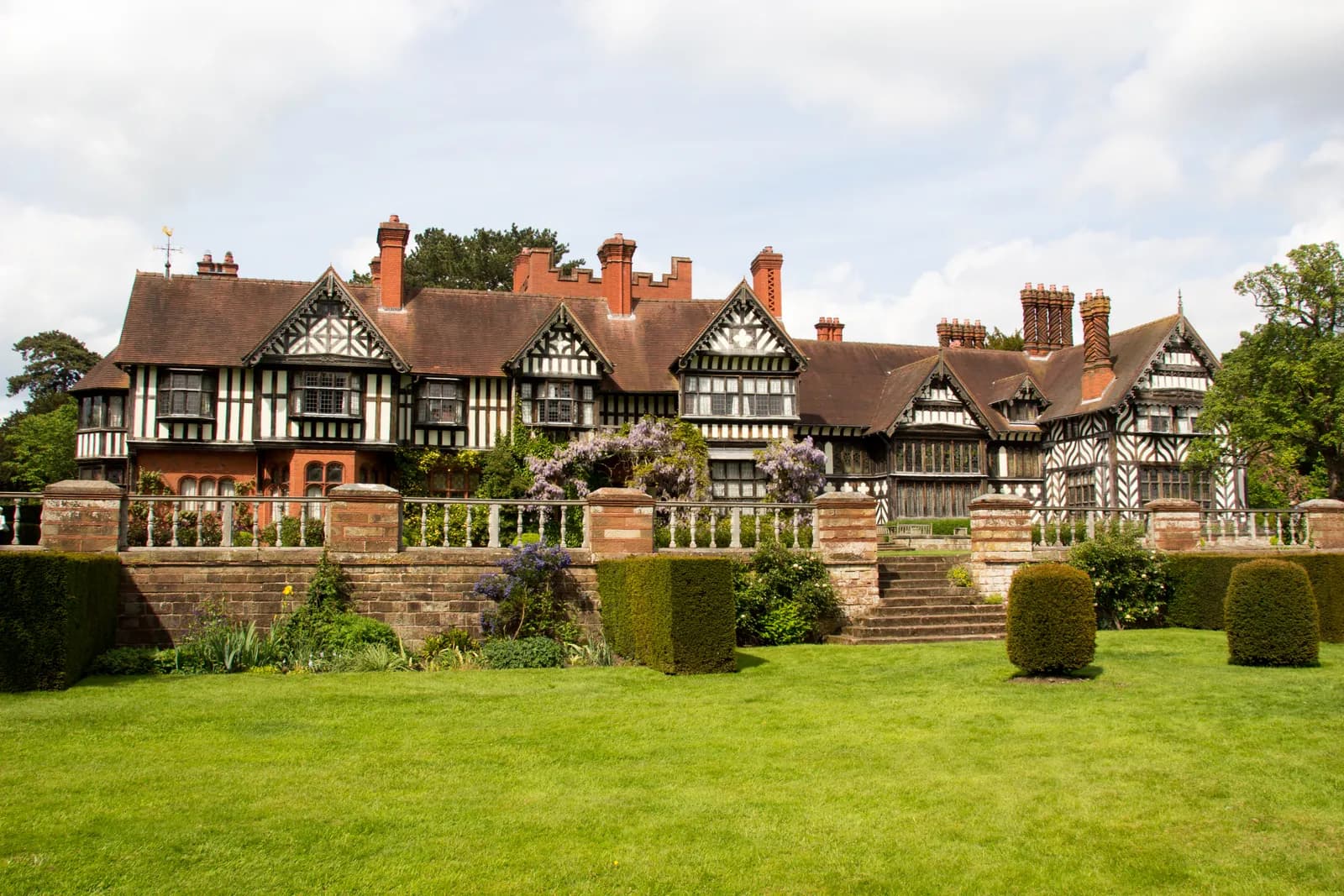
The Mander family's most enduring cultural contribution to Wolverhampton is Wightwick Manor, built in two phases in 1887 and 1893 for Theodore Mander to designs by Edward Ould. The house was inspired by notes Theodore took at an Oscar Wilde lecture on "The House Beautiful" delivered in Wolverhampton in 1884.
The Grade I listed building is a masterpiece of the "Old English" Tudor Revival style and contains outstanding collections of William Morris & Co. wall hangings, wallpapers, and upholstery, tiles by William De Morgan, and stained glass by Charles Kempe. The Pre-Raphaelite works assembled by Sir Geoffrey and his wife Rosalie include pieces by Dante Gabriel Rossetti, Evelyn De Morgan, Edward Burne-Jones, Ford Madox Brown, and John Everett Millais.
In 1937, Sir Geoffrey Mander gave Wightwick Manor and its collections to the National Trust, making it the first country house to be presented to the nation during the donor's lifetime. The Mander family retained the use of an apartment in the house, which remains open to the public today.
Educational and Cultural Philanthropy
Charles Benjamin Mander (1819–1878) was the driving force behind the establishment of the first publicly funded institution for art education in Britain in 1852. He also campaigned for clean drinking water fountains and a free library in Wolverhampton.
Theodore Mander was one of the founding benefactors of Mansfield College, Oxford, the first Nonconformist college in the university, and endowed a scholarship at Birmingham University.
The Mander Centre: Reinventing the City Centre
The Mander family's physical imprint on Wolverhampton continued into the 20th century with the development of the Mander Centre, which opened on 6 March 1968. Developed by Manders Holdings Plc and designed by architect Stanley Sellers, the centre was built on four and a half acres comprising the old Georgian works and offices of the Mander family firm, as well as the site of the former Queen's Arcade, which had been promoted by Charles Tertius Mander in 1902 but destroyed by fire in May 1974.
With a floor area of 620,000 square feet, the Mander Centre became Wolverhampton's principal shopping destination. Sir Charles Marcus Mander (1921–2006) was the developer behind both the centre and the Perton township, built on the family's agricultural estate to house 11,500 people.
The End of an Era
The Mander Brothers business was sold piecemeal during the 1990s. The paints and coatings businesses were acquired by the French Total S.A. Group, whilst the printing inks division was sold to Flint Ink Corporation of Detroit in 1998. The Financial Times noted that this sale marked "the ending of a long chapter in the British chemicals industry." The property portfolio, including the Mander Centre, was sold to the Prudential Insurance Company.
The Mander Centre has since changed hands multiple times, acquired by Delancey Estates and Royal Bank of Scotland in 2010, then by Benson Elliot Capital Management for £59 million in December 2014. It underwent a major £25–35 million refurbishment between 2016 and 2017.
A Lasting Legacy
Although the Mander family no longer owns businesses in Wolverhampton, and Sir Charles Nicholas Mander, 4th Baronet, now lives at Owlpen Manor in Gloucestershire, the family name endures throughout the city. The Mander Centre and Mander Square remain central to Wolverhampton's retail district, whilst Wightwick Manor stands as one of the National Trust's most significant properties, attracting visitors from across the world to appreciate its Arts and Crafts collections.
From Thomas Mander's arrival in 1742 to the present day, the family's story is inseparable from that of Wolverhampton itself. They were industrialists, reformers, politicians, and philanthropists who believed that commercial success carried an obligation to improve the lives of their workers and the cultural fabric of their city.