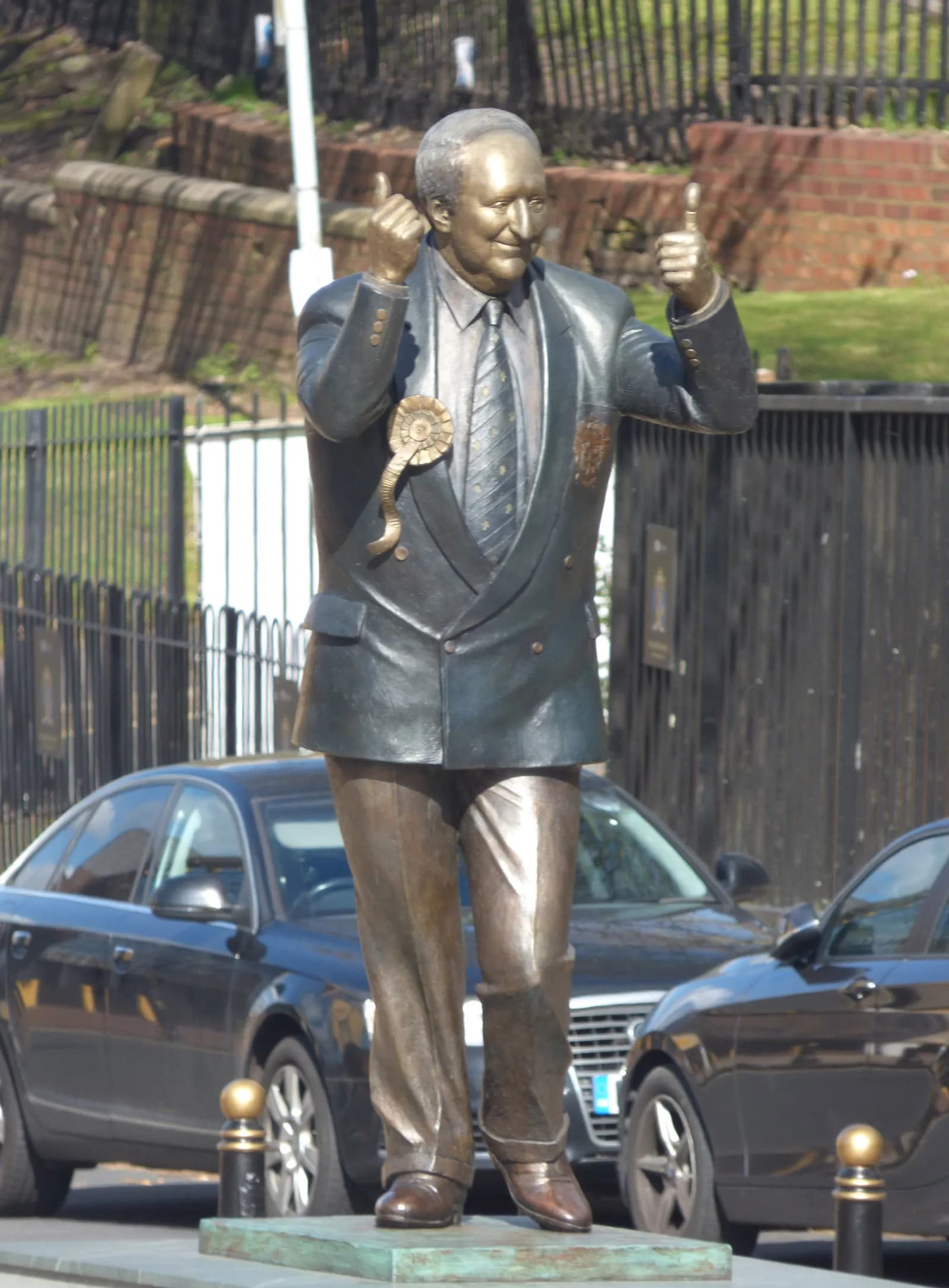
Sir Jack Hayward, the Wolverhampton-born industrialist who poured more than £70 million into saving his boyhood football club, remains one of the most generous benefactors in English football history. Born in the Whitmore Reans area of Wolverhampton on 14 June 1923, Hayward transformed Wolverhampton Wanderers FC from a club facing financial ruin into a modern institution with a redeveloped stadium bearing his name.
From Toolmaker's Son to Global Businessman
Hayward's wealth traced back to his father, Sir Charles William Hayward, who began as a tool and pattern maker in Wolverhampton before diversifying into manufacturing motorcycle sidecars and car bodies for Morris and Rootes. The family eventually built Firth Cleveland, an engineering and steel conglomerate.
Hayward served as a pilot officer in the RAF during the Second World War, flying Dakota transport aircraft in Burma under South East Asia Command. After demobilisation in 1946, he joined the family business, working in South Africa as an agricultural equipment salesman before founding the American arm of the group in New York in 1951. He relocated to the Bahamas in 1956, where he became vice-president of the Grand Bahama Port Authority and helped develop Freeport.
Saving Wolverhampton Wanderers
Hayward had his first opportunity to buy Wolves in 1982 when the club was £2.5 million in debt and had been relegated from the First Division. He declined that offer of 400 shares for around £40,000. By May 1990, he was determined to act, purchasing the club for £2.11 million.
Over the following 17 years as chairman, Hayward invested more than £70 million of personal finance into the club. This funded the complete redevelopment of Molineux Stadium, annual debt write-offs, and player acquisitions. The club enjoyed only one Premier League season during his tenure, in 2003–04, yet Hayward never wavered in his commitment.
In May 2007, he announced the sale of Wolves to businessman Steve Morgan for a nominal £10 fee, conditional upon Morgan investing £30 million in the club. The takeover was formally completed on 9 August 2007. Hayward remained Life President of the club and was inducted into the Wolves Hall of Fame in 2011.
The SS Great Britain Rescue
Beyond football, Hayward played a pivotal role in preserving British maritime heritage. In 1970, he funded the rescue of the SS Great Britain, which had been abandoned in the Falkland Islands for 33 years after being scuttled in 1937. He paid for the vessel to be raised, repaired sufficiently to be towed, and transported back across the Atlantic to Bristol, where she had been built 127 years earlier. The ship is now a museum vessel and major visitor attraction in Bristol Harbour, listed as part of the National Historic Fleet.
Lundy Island and Other Conservation Work
In 1969, Hayward purchased Lundy Island, the largest island in the Bristol Channel, for £150,000. He immediately donated it to the National Trust, and it is now managed by the Landmark Trust. The island, which measures three miles long and one kilometre wide, lies 12 miles off the coast of Devon.
His maritime conservation efforts extended further. He spent £100,000 on saving the sloop Gannet, the Royal Navy's only surviving vessel from the transition from sail to steam, and contributed a further £100,000 towards raising the Mary Rose.
Honours and Legacy in Wolverhampton
Hayward received the Freedom of the City of Wolverhampton on 9 July 2003. His 80th birthday that year was marked by the renaming of Molineux Way to Jack Hayward Way. Following his death on 13 January 2015 in Fort Lauderdale, Florida, at the age of 91, the South Bank of Molineux was renamed the Sir Jack Hayward Stand.
A bronze statue of Hayward, sculpted by James Butler and unveiled in 2018, now stands outside Molineux Stadium near Ring Road St Peter's. The Wolves training complex at Compton also bears his name as the Sir Jack Hayward Training Ground.
Broader Philanthropy
Hayward's charitable giving extended well beyond Wolverhampton. He donated £1 million to repair the King Edward VII Memorial Hospital on the Falkland Islands following the Falklands War, and gave a further £1 million anonymously to the South Atlantic Fund to aid families of British servicemen killed or injured in the conflict.
He financed three international racing yachts named Great Britain II and III, and sponsored the first Women's Cricket World Cup in 1973, two years before the inaugural men's tournament. He also financed England women's cricket tours of the West Indies in 1969–70 and 1970–71.
In 1968, he was appointed OBE, and was knighted in 1986 for charitable services. A school in Freeport, Bahamas, was named Sir Jack Hayward High School in 1998, and the Grand Bahama Highway Bridge was renamed the Sir Jack Hayward Bridge in March 2016.